College Ready · US college & transfer preparation
Trinity Admission / Four-week pilot proposal
A maximum. But the right one?
Build a function. Find its maximum. Test the conditions behind the conclusion. See how one teacher question changes both the maths and the written argument.
One click. No sign-in or setup.
Try the maths and writing demos. Classroom delivery and combined weekly records remain proposed.
College Algebra · Quadratic modelling
A 140-seat campus event. At a ticket price of p dollars, predicted demand is q people. Venue hire is $120; each attendee costs $5. Which price maximises profit?
- Demand
- q(p) = 240 − 8p
- Cost
- C(n) = 120 + 5n
0 ≤ p ≤ 30 · Modelled sales n = min(seats, q). Assume the demand model is realised.
The student finds the quadratic’s vertex correctly. But does the price with the highest revenue also produce the highest profit?
What you can try. What we would plan together.
Hands-on demo
Maths · Working and retries
Write by hand, replay the strokes and try again after feedback. Guest records stay in the current tab.
Simulated review
Writing · Draft and revision
Use the prepared example to review, approve and revise, then download the activity. No real teacher or AI assessment is connected.
Proposal · Scope and price to agree
Institution · One class, four weeks
Agree the class, reviewers and task load first. Classroom delivery and combined maths and writing records are proposed work.
01 / Between lessons
The answer is only part of the story.
Where did the student get stuck? How did they use the feedback? The next lesson can begin with what changed between attempts.
- 01
Students leave a trace
Keep the first attempt, without a teacher watching every moment.
- 02
Teachers respond
Let the subject teacher review the work and set a clear next step.
- 03
The next attempt tells more
Look at what changed, as well as whether the feedback was read.
02 / A working maths notebook
A fresh attempt. The original stays.
Handwritten work and teacher annotations are kept separately. After the teacher reviews and releases feedback, a student can try again and compare both attempts.
01 First attempt
Keep the original handwriting and the order of the strokes.
02 Teacher review
Annotate the work and release feedback only after reviewing it.
03 Try again
Submit a new solution, then compare it with the first attempt.
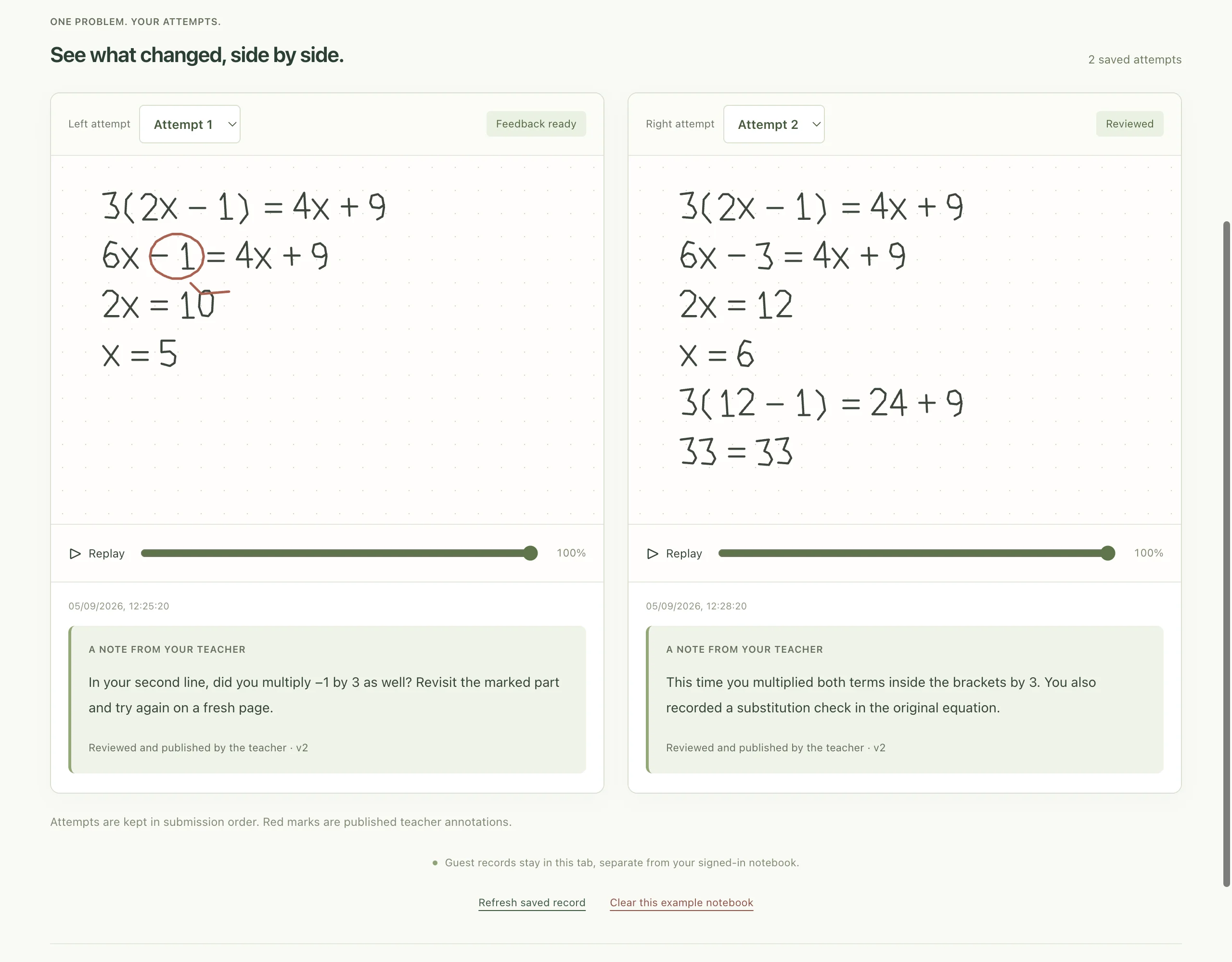
The separate notebook below uses an introductory equation to demonstrate handwriting tools. Its records are not connected to the event-pricing task above. It is not a SAT or ACT item or a calibrated assessment. Guest records stay in the current tab.
Try the maths notebook03 / Writing & weekly review
A clearer reason. In their own words.
Turn the revised mathematical decision into a claim, evidence and conditions in English. The excerpts below use the event-pricing task. The separate writing demo uses a study-room task to try submission, review, approval and revision.
Original synthetic example · Records are not connected to the separate writing demo. Real teacher and AI assessment, and combined weekly records, remain proposed.
Write a 120–160-word pricing recommendation to the student committee. Distinguish revenue from profit, explain what changes with 80 rather than 140 seats, and state a limitation of the demand model. Excerpts follow.
01 / First draft
The revenue function reaches its maximum at $15, so this is the most profitable ticket price. We should keep this price even if the venue becomes smaller.02 / Revised draft
With 140 seats, $17.50 maximises predicted profit at $1,130, although $15 generates more revenue. With only 80 seats, I would recommend $20, giving a predicted profit of $1,080. Both recommendations depend on the assumed demand model.Example feedback — Does a revenue maximum justify a claim about profit? Explain why the seat limit changes the recommendation, and distinguish a model prediction from an observed result.
What a weekly record could include
- Maths focus
- Check the completed-square profit model and whether demand at the vertex fits the seat limit.
- Writing focus
- Check that the argument distinguishes revenue from profit and connects numerical evidence, capacity and the demand assumption.
- Next step
- Change capacity or fixed cost, then explain when the optimal price changes and when it stays the same.
The weekly record above is a proposal. The current writing download contains only this demo’s writing activity and is not connected to the maths notebook or an institution account. All examples are original and synthetic.
04 / A four-week pilot proposal
One existing class. Four focused weeks.
We propose one focused maths task and one short writing task each week. A four-week paid pilot in an existing class would pair named subject reviewers with a review of student retries and teacher workload.
- 01WEEK
Agree the scope
Choose the class, task level, subject reviewers and feedback criteria.
- 02WEEK
Complete the first cycle
Review the maths and writing, then guide the next attempt.
- 03WEEK
Check the workload
Review resubmissions and teacher time, then adjust the task load.
- 04WEEK
Decide what comes next
Use the work and actual operating costs to decide whether to continue.
Before starting, agree the class and group size, maths and writing reviewers, task load, feedback schedule and price. Content rights, student-data handling and operating arrangements must also be settled.
After four weeks, use the records to decide
- Student retries
- Compare first submissions with attempts made after feedback. Review what changed and where students stopped.
- Teacher workload
- Record review time per task and outstanding work. Check whether the process fits within existing teaching capacity.
- Scope and cost of continuing
- Use participation, task volume and operating costs to decide whether to continue, adjust or stop. Learning gains are not promised in advance.
05 / Start a conversation
Which class would you start with?
If you already teach a class preparing for US college entry or transfer, we can start by defining a scope that fits your course.
Tell us about the course, student level, approximate group size and available subject reviewers. No personal student information is needed.
Send the form to see whether your enquiry was received. You can also contact us by email.
Enquire by email